
Sweet Relief: Understanding Medicaid's Glucometer and Diabetic Supply Coverage
Why Medicaid Glucometer Coverage Matters for Your Diabetes Care
Medicaid glucometer coverage is a critical benefit that helps millions of Americans with diabetes afford the blood sugar monitoring supplies they need to stay healthy. If you're managing diabetes and rely on Medicaid, understanding what's covered can save you money and stress.
Quick Answer: How Medicaid Covers Glucometers
- Coverage varies by state - Each state decides which glucometer brands and supplies are covered
- Most states cover common brands - OneTouch, Contour Next, and Accu-Chek are frequently covered
- You need a doctor's prescription - Your healthcare provider must document your need for testing supplies
- Quantity limits apply - Insulin users typically get more test strips (up to 300 per 3 months) than non-insulin users (up to 100 per 3 months)
- Coverage may be through pharmacy or DME - Some states cover glucometers through pharmacy benefits, others through Durable Medical Equipment
Over 37 million Americans have diabetes, and for those on Medicaid, access to glucometers is vital. The good news? Most states cover glucometers and related supplies through Medicaid. The challenge is that coverage varies by state, and figuring out your specific plan's rules, preferred brands, and approval process can be tricky.
As of May 2023, 45 states and Washington D.C. provide some level of coverage for diabetes monitoring equipment. However, the specific brands, quantity limits, and whether you need prior authorization can differ significantly depending on where you live and your plan.
This guide will walk you through everything you need to know about getting a glucometer covered by Medicaid, from understanding your state's specific coverage rules to finding approved suppliers.
What is Medicaid and How Does It Cover Diabetic Supplies?
Medicaid is a joint federal and state program that helps cover healthcare costs for millions of Americans with limited income, including those managing chronic conditions like diabetes.
While the federal government sets basic ground rules, each state customizes its own program. This means Medicaid glucometer coverage can look quite different depending on where you live. It's essential to understand your specific state's policies. You can find your state's Medicaid contact information and details at Medicaid.gov's state contact page.
Medicaid typically covers diabetic supplies like glucometers through one of two pathways:
- Durable Medical Equipment (DME): This category includes equipment that is built to last and serves a medical purpose, like a glucometer.
- Pharmacy Benefits: An increasing number of states are shifting coverage to this pathway, allowing you to pick up your glucometer and test strips at your local pharmacy with a prescription.
For example, Florida moved diabetic supplies from DME to pharmacy benefits in October 2024. Always check with your state Medicaid agency to see how your supplies are covered.
Understanding Your Plan: State vs. Managed Care
Even within the same state, not all Medicaid plans work the same way. You might be in one of two main types:
- State fee-for-service plans are run directly by the state, with consistent coverage rules for everyone in the program.
- Managed Care Organizations (MCOs) are private insurance companies that contract with the state to provide Medicaid benefits. Most beneficiaries are in MCOs. Each MCO has its own formulary (a list of covered supplies) and may prefer certain brands, though they must meet state minimums.
Your plan handbook and your MCO's member services line are your best resources for understanding what's covered under your specific plan.
How Coverage Policies Can Change
Medicaid coverage isn't set in stone; policies can change for several practical reasons:
- Preferred Product Lists (PPLs): State agencies and MCOs negotiate with manufacturers for better prices. When they get a good deal, those products become "preferred." You may need to switch to a preferred brand to keep your costs low.
- Annual Updates: Formularies are typically reviewed each year. What was covered last year might change, or new products may be added.
- Manufacturer Contracts: When contracts between insurers and manufacturers change, so can your coverage for specific brands.
The key is to stay informed. Check for updates to your plan's coverage regularly to avoid surprises at the pharmacy.
Your Guide to Medicaid Glucometer Coverage
Understanding medicaid glucometer coverage means knowing which brands your plan prefers and what rules apply. Medicaid plans negotiate deals with certain manufacturers to keep costs down, which means some brands are easier to get covered than others.
Commonly Covered Glucometer Brands
Most Medicaid plans have a list of preferred glucometer brands. Our research across dozens of health plans shows that OneTouch, Contour Next, and Accu-Chek consistently appear on covered lists. These are well-established brands known for their accuracy and reliability.
For example, Florida's Diabetic Supply Preferred Product List includes specific models like Accu-Chek Guide and Contour Next meters and their corresponding test strips. However, these lists can change based on new contracts. If you're in a Managed Care Organization (MCO), it may have its own preferences. Always check your specific plan's formulary before ordering supplies.
Navigating Limitations and Restrictions on your Medicaid Glucometer Coverage
Even with coverage, your plan will have rules based on medical guidelines about how many supplies you can receive.
Quantity limits are the most common restriction. Your plan sets a maximum number of test strips and lancets you can get in a given period (usually monthly or quarterly). This amount depends on your treatment plan:
- Insulin users typically qualify for more supplies, as they need to test more frequently. Many plans allow up to 300 test strips and 300 lancets every three months (about 3-4 tests per day).
- Non-insulin users who manage diabetes with diet and oral medications usually have a lower allowance, often around 100 test strips and 100 lancets every three months.
If your doctor wants you to test more often than the standard limit allows, they can submit doctor's documentation explaining the medical necessity for additional supplies.
Another common rule is the preferred meter requirement. If you own a glucometer that isn't on your plan's preferred list, your plan likely won't pay for its test strips. This can leave you paying out of pocket for expensive strips. The solution is often to switch to one of your plan's preferred meters. At ProMed DME, our team can help you identify which meters your plan covers and get you set up with the right equipment, so you're not left with unusable supplies.
How to Get a Glucometer Covered by Medicaid: A Step-by-Step Guide
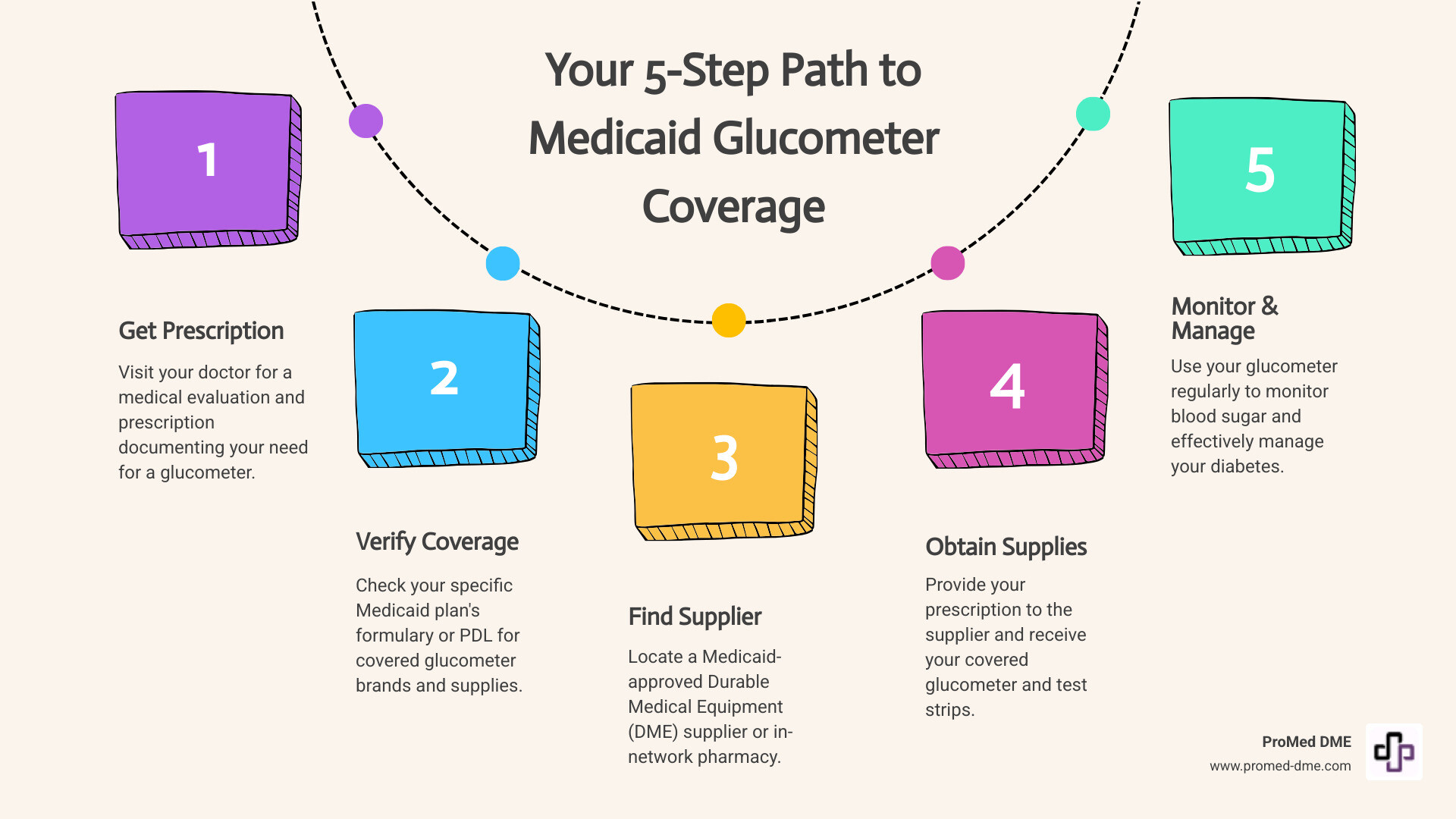
Getting your medicaid glucometer coverage sorted out is a manageable process. Follow these steps to get the supplies you need without the stress.

Step 1: Visit Your Doctor and Get a Prescription
Your first step is to visit your doctor for a medical evaluation and prescription, which is the foundation of your coverage. The prescription must be detailed, documenting your specific diabetes diagnosis (e.g., Type 1, Type 2), why blood glucose monitoring is medically necessary, and how often you need to test. This testing frequency directly determines the quantity of test strips and lancets you're eligible to receive. The prescription should also confirm that you can be trained to use the device safely.
Step 2: Determine if Your Plan Covers a Particular Glucometer
With your prescription, you need to find out which glucometers your Medicaid plan will pay for. The best way to do this is by checking your plan's formulary, also known as a Preferred Drug List (PDL). You can usually find this on your Managed Care Organization's (MCO) or state Medicaid agency's website. You can also call the member services number on your ID card or check your plan's online portal. Ask about preferred brands, quantity limits, and prior authorization needs. Medicaid glucometer coverage policies can change, so it's wise to verify your benefits before ordering.
Step 3: Find a Medicaid-Approved Supplier
Now you need to find a provider that can supply your glucometer and accepts your Medicaid coverage. Depending on your state, this may be a Durable Medical Equipment (DME) supplier or your local pharmacy. The key is to find a provider that is enrolled in Medicaid and accepts your specific plan.
Before committing, always verify their participation. Ask directly: "Do you accept Medicaid?" and "Do you accept my specific Managed Care Plan?" This simple step can save you from unexpected bills.
This is where we at ProMed DME can help. Based in Stuart, Florida, we understand how Medicaid coverage works. We work with most insurance plans, including Medicaid, to minimize your out-of-pocket expenses. Our team, which includes a dedicated nurse, can answer your questions and help you steer your coverage. We'll verify your benefits, submit claims on your behalf, and ship your supplies for free anywhere in the United States, making the process as convenient as possible.
What Other Diabetic Supplies Does Medicaid Cover?
Good news: medicaid glucometer coverage is just the beginning. Most state Medicaid programs, including Florida's, provide comprehensive coverage for the full range of diabetic supplies you need to stay healthy and avoid complications. Your glucometer is essential, but you also need test strips, lancets, and, if you're on insulin, the medication and supplies to administer it. Medicaid typically covers these essentials, though specific brands and quantities can vary.
Commonly Covered Diabetic Supplies
While coverage depends on your state and plan, most Medicaid programs cover these essential supplies:
- Blood glucose meters (glucometers) - The devices that measure your blood sugar levels
- Blood glucose test strips - The strips that work with your meter to provide readings
- Lancets and lancing devices - Small needles and the devices that hold them for obtaining blood samples
- Insulin - A critical medication for many people with diabetes
- Syringes and needles - For administering insulin injections
- Insulin pens - Pre-filled devices that make insulin delivery easier
- Insulin pumps and supplies - For continuous insulin delivery, typically for those who meet specific medical criteria
- Glucagon emergency kits - For treating severe low blood sugar
- Ketone testing strips - Used to check for ketones, a sign of a dangerous condition
Some plans also cover alcohol pads and urine glucose-ketone testing strips. Like glucometers, these supplies often have quantity limits based on your treatment plan and your doctor's documentation of medical necessity.
Newer technologies like Continuous Glucose Monitoring (CGM) systems are also increasingly covered by Medicaid, though they usually require meeting specific criteria. Talk with your doctor to see if you qualify.
At ProMed DME, we understand that navigating insurance coverage can be overwhelming. We work with most insurance plans, including Medicaid, to help minimize your out-of-pocket costs. With a nurse on staff and a commitment to great service, we're here to help you get all the diabetic supplies you need.
Frequently Asked Questions about Medicaid Coverage
Navigating insurance can be confusing. Here are answers to some of the most common questions about medicaid glucometer coverage and diabetic supplies.
What if my Medicaid plan doesn't cover my preferred glucometer?
It's frustrating when a familiar device is no longer covered, but you have options. First, you can work with your doctor to file an appeal. They can submit a letter of medical necessity explaining why that specific meter is essential for you. Second, look into manufacturer assistance programs, which can reduce out-of-pocket costs. Finally, the simplest solution may be to switch to a covered, preferred glucometer, which your doctor can help you select.
How do I find out exactly what my state's Medicaid plan covers?
Knowing your specific coverage details is empowering. The best sources for this information are:
- Your state's Medicaid agency website (for Florida, this is the Agency for Healthcare Administration or AHCA).
- Your member handbook, which you can usually download from your plan's website.
- The customer service hotline on the back of your Medicaid ID card.
- Your Managed Care Organization's (MCO) plan formulary documents, which are available on their website.
Are there alternatives if I'm not covered by Medicaid?
If you don't qualify for Medicaid or have a coverage gap, you still have ways to access affordable diabetic supplies:
- The Affordable Care Act (ACA) marketplace at Healthcare.gov may offer subsidized health insurance plans.
- Community health centers and Federally Qualified Health Centers (FQHCs) often provide care on a sliding scale based on income.
- Discount cards and programs at pharmacies can offer savings on supplies.
- Manufacturer patient assistance programs can help with the cost of insulin and other medications. Many glucometer companies also offer free meters or discounts.
We at ProMed DME are here to help you steer your insurance coverage. With our experience and a nurse on staff, we can help you understand your options and minimize your costs.
Conclusion
Understanding medicaid glucometer coverage is a real accomplishment, especially since rules can vary so much. Knowing how to access your diabetic supplies is a key step in managing your health, and it's absolutely possible to get your glucometer and supplies covered by Medicaid.
The process starts with your doctor, continues with checking your plan's details, and ends with finding a supplier who accepts your insurance. You're not alone in this.
At ProMed DME, we believe managing diabetes shouldn't drain your wallet or energy. Based in Stuart, Florida, we're built on a promise of exceptional customer service and top-quality products. We offer free shipping across the United States, have a dedicated nurse on staff to answer your questions, and work with most insurance plans, including Florida Medicaid, to keep your out-of-pocket costs low.
Being proactive about your medicaid glucometer coverage is about taking control of your health. If you're feeling uncertain about your coverage or just need someone to walk you through the process, we're here to help. We steer insurance paperwork every day and would be honored to help you get the supplies you need without the stress.
Learn more about our diabetes supply services and let us help you take the next step toward easier, more affordable diabetes management.
Related Resources & Articles
Stay informed with our informative blog posts.
Discover the ProMed Advantage
& Try Our Products
We offer free shipping and legendary customer service to ensure you receive the
best DME products for your needs.